
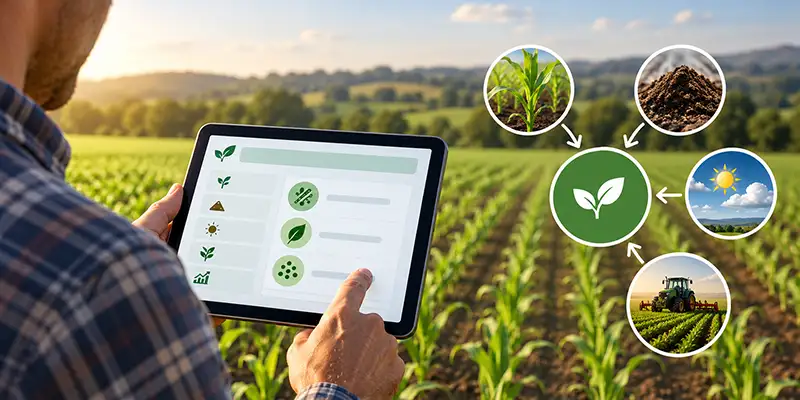
Farmers today face a dual challenge, meaning reducing the use of synthetic fertilisers and pesticides while maintaining productive and profitable farming systems. At the same time, the range of biological solutions available to agriculture – including microbial inoculants, biofertilisers and biostimulants – is rapidly expanding.
But having more solutions available does not necessarily make the farmer’s decision easier.
The performance of biological modulators can vary depending on the crop, soil characteristics, climate, farming practices and stress conditions. A solution that performs well in one context may therefore not be the most appropriate choice in another. Without adequate guidance, farmers may face inconsistent results, unnecessary trial-and-error and ultimately lose confidence in promising biological alternatives.
Turning complex information into practical recommendations
Within TRIBIOME, a Digital Decision Support System (DSS) is being developed to help bridge this gap.
The principle is straightforward: bring together relevant information about the field, crop and farming context and translate it into practical support for selecting biological modulators.
The DSS combines field and agronomic observations with microbiome-related information, environmental conditions and management parameters. It considers factors such as crop needs, soil conditions, climate and potential stress factors, together with the characteristics of the available biological products.
Instead of asking farmers to navigate this complexity alone, the objective is to help them identify a solution that is better adapted to their specific situation.
A tool that can learn from the field
Another important aspect of the approach is feedback.
After applying a biological solution, farmers can monitor crop response and record the results. Field validation, observed outcomes and farmer feedback can then contribute to improving future recommendations.
Over time, this creates a learning process in which experience from real agricultural conditions can make the DSS increasingly relevant to local contexts.
The Practice Abstract therefore recommends regularly updating information such as crop stage, weather and soil observations, monitoring crop response after application and reusing farm data from one season to the next. Importantly, digital recommendations should complement, rather than replace, agronomic advice and farmers’ own field experience.
Why does this matter?
Supporting better selection of biological modulators could help reduce trial-and-error and make the use of these solutions more targeted and efficient.
For farmers, the expected benefits include greater confidence in decision-making, more precise use of inputs, potential reductions in input costs and support for crop performance. From an environmental perspective, more targeted use of biological solutions can contribute to soil health and biodiversity, improved nutrient-use efficiency and more sustainable farming practices.
The approach is also valuable for research. Anonymised field data can help researchers better understand how microbiome-based products perform under different real-world conditions and improve the models behind future recommendations.
Ultimately, the challenge is not simply to develop new biological solutions. It is also to give farmers the knowledge and tools needed to use the right solution, in the right context.
This is one of the ways TRIBIOME is working to turn complex microbiome knowledge into practical support for more sustainable agriculture