
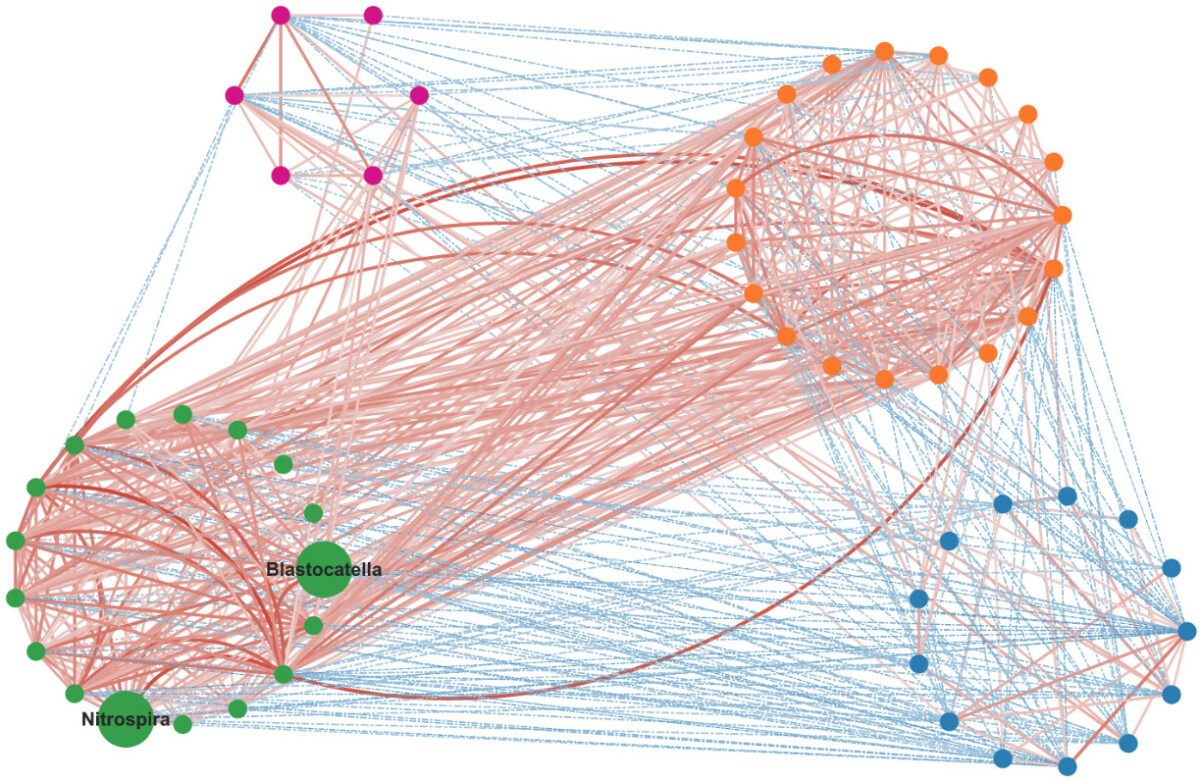
Wiggum plot representing the correlations of each selected genera in the 4 Co-Abundance Groups for the Triticum Durum rhizosphere samples collected from Italy fields. Each node represents a bacterial genus, connections between nodes represent positive (red) and negative correlation (blue) between genera.
Across agricultural landscapes, an invisible world is constantly at work beneath our feet. Billions of microorganisms interact within the soil and around plant roots, shaping crop resilience, nutrient availability, and the capacity of plants to withstand environmental stress. Within the TRIBIOME project, the University of Bologna and University of Pretoria have focused on understanding these hidden microbial relationships.
Rather than studying microorganisms individually, their work investigates the soil microbiome as a dynamic ecological network. Using advanced sequencing technologies and computational modelling approaches, University of Bologna analyzed microbial communities associated with wheat cultivation across contrasting environmental conditions in Italy, Spain, and South Africa. The objective was to identify “keystone” microorganisms and microbial modules that become particularly relevant under high-aridity conditions.
One of the most important outcomes of this work has been the identification of recurring bacterial and fungal genera associated with drought resilience. Several microbial taxa repeatedly emerged as central components of microbial interaction networks under high-aridity conditions, including genera such as Microvirga, Rubrobacter, Paenibacillus, Variovorax, and Blastocatella. These microorganisms are not only recurrent members of drought-associated microbiomes but are also increasingly recognized for functional traits that may support plant adaptation to water limitations.
For instance, bacteria belonging to the genus Microvirga are known for their involvement in nitrogen cycling and for their ability to establish beneficial interactions with plant roots, potentially improving nutrient acquisition under stressful environmental conditions (Ardley et al., 2012). Paenibacillus species are widely studied as plant growth-promoting bacteria because they can produce phytohormones, mobilize nutrients such as phosphorus, and stimulate root development, helping plants maintain growth even during drought stress (Grady et al., 2016).
Other genera identified, such as Variovorax, are particularly interesting because of their metabolic versatility and their capacity to modulate plant hormone balance, including pathways linked to stress responses (Finkel et al., 2020). This could contribute to maintaining root functionality and regulating plant adaptation under fluctuating water availability. Meanwhile, highly stress-tolerant taxa such as Rubrobacter are notable for their remarkable resistance to desiccation and oxidative stress, traits that may contribute to stabilizing microbial communities under prolonged arid conditions and preserving key ecological functions in the rhizosphere (Rainey et al., 2005).
Although less characterized from a functional perspective, genera such as Blastocatella are frequently associated with oligotrophic and dry soils and are thought to participate in carbon turnover and soil ecosystem stability under nutrient-poor conditions (Foesel et al., 2013). Their recurrent enrichment in high-aridity environments suggests a potential ecological role in maintaining resilient microbial networks when environmental conditions become limiting.
Taken together, these findings suggest that drought resilience is not driven by a single “beneficial microbe,” but rather by complex microbial consortia whose members contribute complementary ecological functions. Understanding these cooperative microbial interactions is one of the key objectives of University of Bologna’s work within TRIBIOME project and represents an important step toward the future development of microbiome-based strategies for climate-resilient agriculture.
Building on these findings, University of Bologna also contributed to the validation of selected soil microbiome modulators through controlled mesocosm and in vitro experiments. In dedicated soil column systems simulating different soil depths and moisture conditions, the effects of selected bacterial modulators such as Bacillus spp. and Pseudomonas spp. were evaluated under both optimal irrigation and drought scenarios. The experiments showed that these modulators did not significantly disrupt the native soil microbial communities, while still demonstrating the capacity to transiently colonize the upper soil layers and stimulate microbial activity under favorable moisture conditions. These results suggest that selected modulators may integrate into the rhizosphere ecosystem without destabilizing the resident microbiome, an important prerequisite for the future development of sustainable microbiome-based agricultural applications.
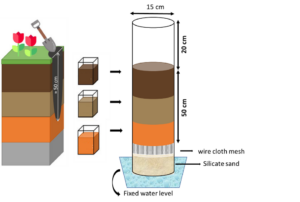
Schematic representation of the soil column mesocosms setting up.
At the same time, in vitro wheat assays at Valgenetics explored the impact of microbial consortia, or “syncoms”, on the growth and physiological response of different wheat varieties under simulated drought stress. While the results highlighted the complexity of plant-microbiome interactions and showed that not all formulations produced measurable improvements under laboratory conditions, they also provided important information regarding microbial compatibility, colonization dynamics, and formulation strategies.
The current phase of the University of Bologna’s work within TRIBIOME is focused on integrating microbiome interaction data with applied agricultural validation activities. This phase, mainly led by other project partners, involves University of Bologna in providing scientific support for the optimization of the most promising microbial consortia, the improvement of formulation strategies, and the transfer of experiments from controlled systems to greenhouse and field conditions. An additional important aspect that still needs to be evaluated concerns understanding how soil characteristics influence the establishment and long-term stability of microorganisms, considering that the same microbial solution may behave differently in clay-rich soils compared to sandy soils.
Ultimately, the work carried out by all the partners involved contributes to a broader vision of agriculture where soil microbiomes are not treated as passive components, but as active biological infrastructures capable of enhancing crop resilience naturally. Beneath every wheat field lies a living network, TRIBIOME project is helping us learn how to read it, understand it, and eventually work together with it.
SOURCES
*
Grady, E. N., MacDonald, J., Liu, L., Richman, A., & Yuan, Z. C. (2016). Current knowledge and perspectives of Paenibacillus: a review. Microbial cell factories, 15(1), 203.
Ardley, J. K., Parker, M. A., De Meyer, S. E., Trengove, R. D., O’Hara, G. W., Reeve, W. G., … & Howieson, J. G. (2012). Microvirga lupini sp. nov., Microvirga lotononidis sp. nov. and Microvirga zambiensis sp. nov. are alphaproteobacterial root-nodule bacteria that specifically nodulate and fix nitrogen with geographically and taxonomically separate legume hosts. International journal of systematic and evolutionary microbiology, 62(Pt_11), 2579-2588.
Rainey, F. A., Ray, K., Ferreira, M., Gatz, B. Z., Nobre, M. F., Bagaley, D., … & da Costa, M. S. (2005). Extensive diversity of ionizing-radiation-resistant bacteria recovered from Sonoran Desert soil and description of nine new species of the genus Deinococcus obtained from a single soil sample. Applied and environmental microbiology, 71(9), 5225-5235.
Foesel, B. U., Rohde, M., & Overmann, J. (2013). Blastocatella fastidiosa gen. nov., sp. nov., isolated from semiarid savanna soil–The first described species of Acidobacteria subdivision 4. Systematic and Applied Microbiology, 36(2), 82-89.
Finkel, O. M., Salas-González, I., Castrillo, G., Conway, J. M., Law, T. F., Teixeira, P. J. P. L., … & Dangl, J. L. (2020). A single bacterial genus maintains root growth in a complex microbiome. Nature, 587(7832), 103-108.
Want to know more?
Contact catherine.malingreau@wagralim.be or Follow the project’s LinkedIn page